

Evidence rules
No source, no score. These are the rules.
Intent data is only useful if you can trust it. These are the rules Diurno HQ applies to what it shows you, and what they look like in the product.
The rules
Eight rules the product follows.
The software applies most of these when research is saved and scored. The research instructions cover the rest. Each rule says where you will see it.
Rule 1: No source, no score.
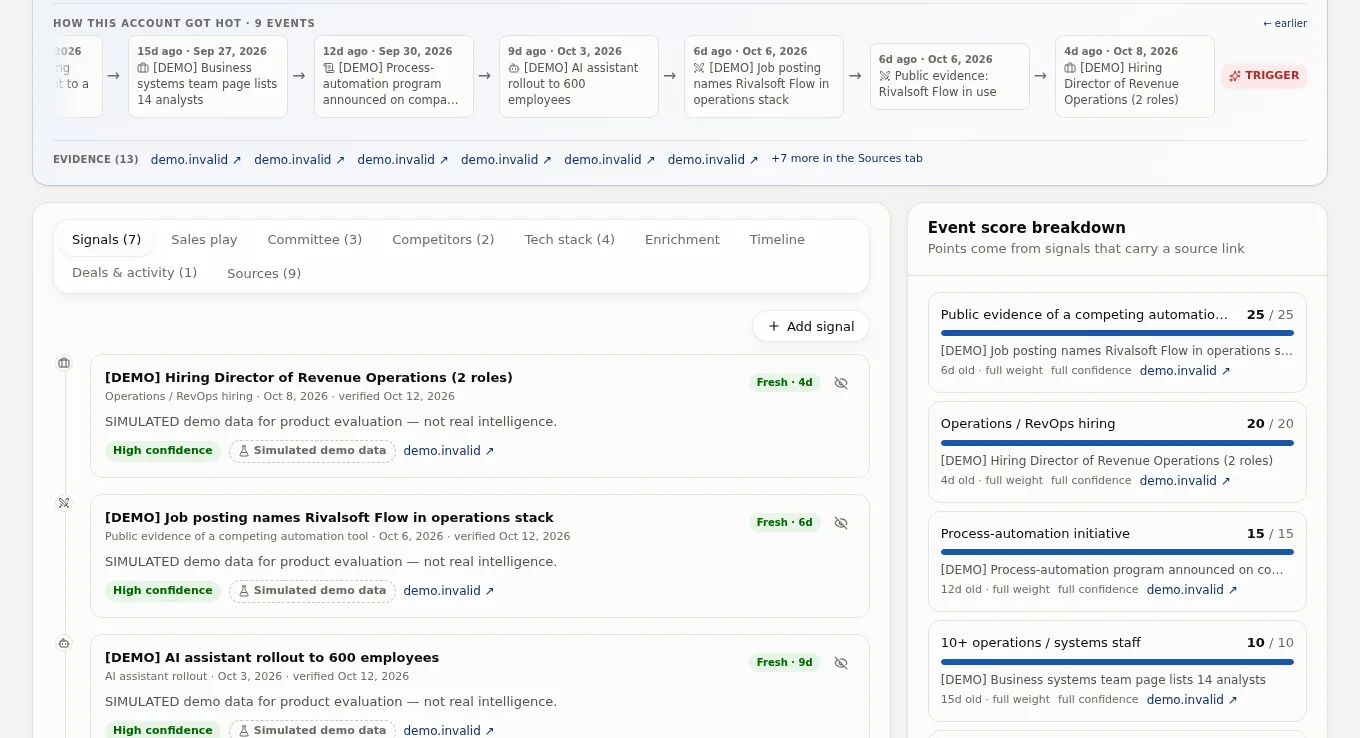
A signal without a source URL is stored as Needs Verification and adds nothing to the Event score.
In the product: A Needs Verification label where the points would be.
Rule 2: Competitors need sources too.
A competitor claim without a source URL is dropped, and the research instructions forbid inferring a competitor from what a company does.
In the product: Competitor evidence shows the link it came from.
Rule 3: Research marks a person Verified only with a source.
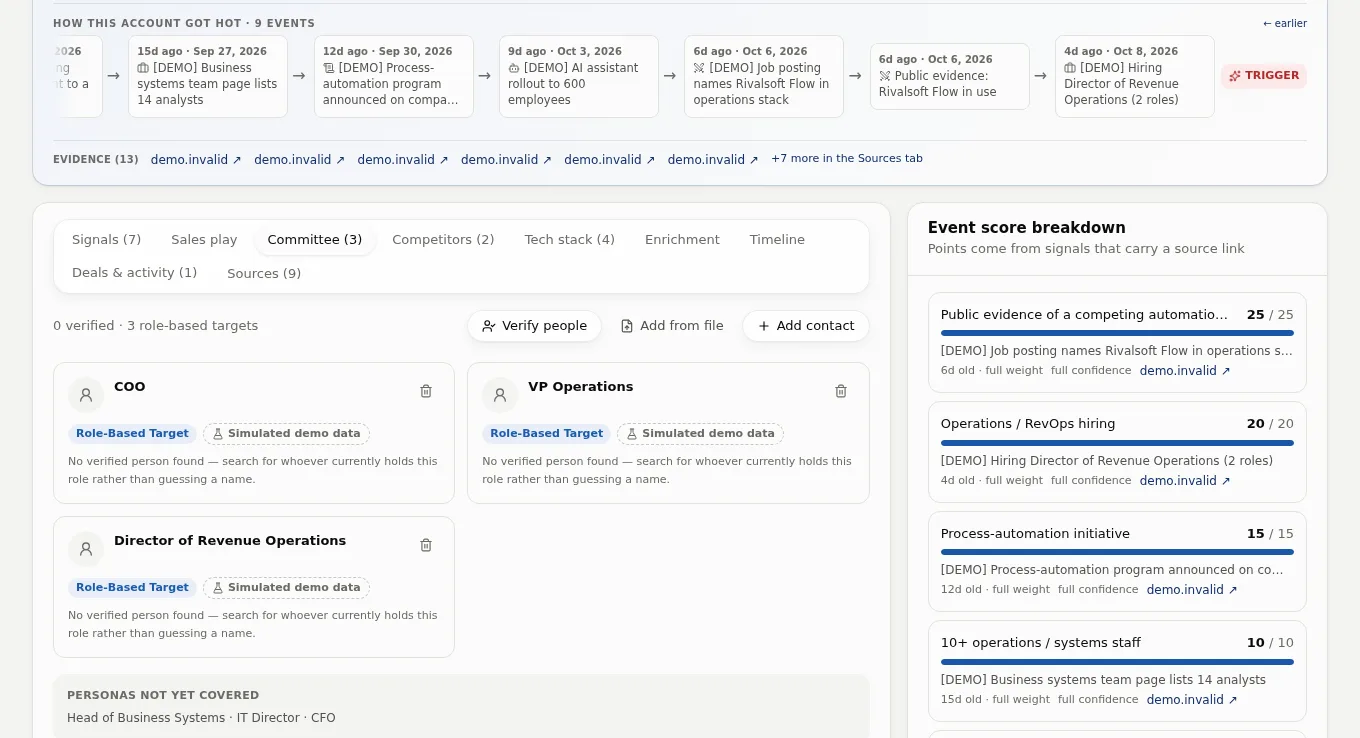
When research cannot link a source to a named person, it returns a role-based target instead; a name with only a profile link is kept as a Needs Verification lead. The research model has no field for email addresses or phone numbers, so it cannot supply them. A contact you add yourself is stored as you enter it and stays Needs Verification until it has a public source link.
In the product: A “Role-Based Target” card reading “No verified person found — search for whoever currently holds this role rather than guessing a name.”
Rule 4: Estimates are labeled or discarded.
A technical-team-size estimate without a source is discarded. A spend range appears only when a verified team size exists, and it is labeled a heuristic.
In the product: “Potential spend … (heuristic)” on the account brief.
Rule 5: Visits are matched by network domain.
A website visit is matched to a tracked company only when the visitor's network name is confirmed (it resolves back to the same address) and belongs to that company's domain; company names are not fuzzy-matched. Networks recognized as ISPs, carriers, clouds or shared platforms stay anonymous counts, and a match means someone on that company's network, not a named person.
In the product: Visitor signals only from confirmed domain matches; the rest stay as counts.
Rule 6: Opens display, human clicks score.
Email opens are inflated by mail-privacy features such as Apple's, so they are shown but not scored. A link click is scored unless it looks automated: security scanners and link previews fetch links within seconds of delivery, and those requests are recorded as automated and score nothing.
In the product: Opens as an informational count; clicks as scored engagement; automated fetches labeled as such.
Rule 7: Ambiguity fails loudly.
When research reports that it cannot tell which company you mean, the job fails with a clear message instead of guessing.
In the product: A failed job with a plain-language reason.
Rule 8: Simulated data is labeled.
Demo evidence is flagged as simulated and attached only to fictional companies, so it cannot pass for real intelligence.
In the product: A “Simulated demo data” chip on demo signals, contacts, competitors and technologies, and “(Demo)” in demo company names.
See it
The rules, on screen.
Two views from an example workspace. The companies are fictional and the demo signals are labeled as simulated.
Check it on your own accounts.
The pilot runs the full loop on your target list. Open an account and follow its signals back to their sources.