

Customer intent intelligence
Know who is ready to buy — and why.
Diurno HQ researches the accounts you sell to, finds the ones showing real buying triggers, and gives your reps a short list each morning: who to contact, why now, and what to say. Research saves signals with their source links, and anything unsourced is labeled and scores zero.
Priced by accounts monitored, not per seat. Invoiced, with no credit card required to start. The pilot fee is credited toward an annual plan.
- Research saves signals and people with their source link
- Unsourced signals score zero
- Research marks a person Verified only when a public source does
- Website visits matched by network domain, not by name
Intent you can act on
We don't tell you who's researching. We tell you who's likely buying — and why.
Triggers, not guesses
Open roles, tools named in a company's stack, leadership changes, funding, compliance drivers and visits to your own site become dated signals, saved with the page they came from.
Fit says whether. Event says when.
A researched account gets two scores: is this your kind of customer, and is something happening now? Signals lose weight as they age, so last quarter's news doesn't look like this week's.
Reasons you can check
An Event score is built from signals that carry a source link and an age, and a signal with no source scores zero. Open an account to see how it got hot.
How it works
From your target list to a morning to-do list.
Step 1: Tell us who you sell to
Your ideal customer profile, buyer personas and competitors. In a pilot we configure this with you.
Step 2: Research runs overnight
A research agent works through your accounts in overnight batches. It reads careers pages, job boards, press releases and news, and records findings with their sources. New results and alerts appear as each batch finishes.
Step 3: You get a short list each morning
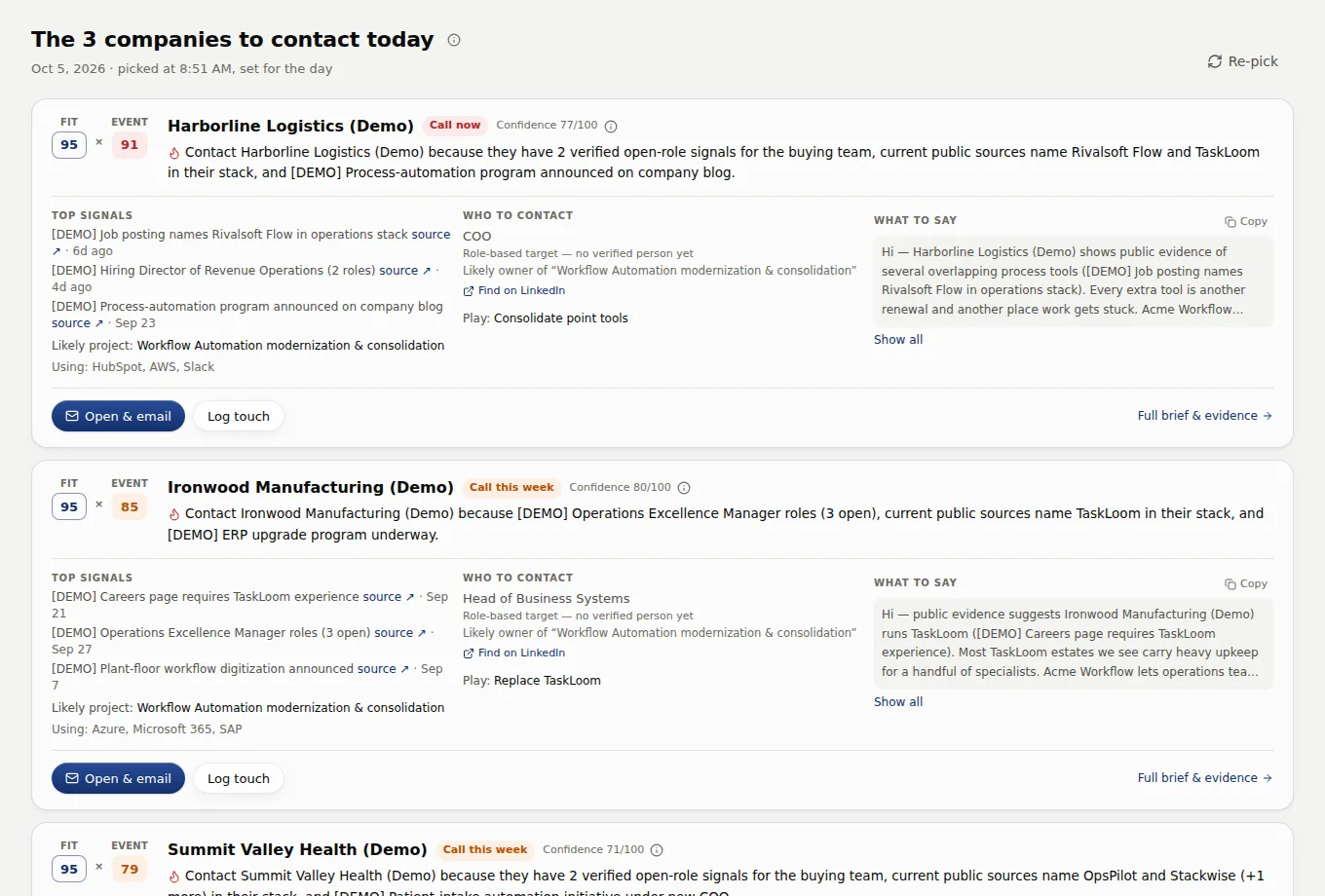
Today lists the companies to contact, built once each morning, with a why-now sentence, the signals behind it, a suggested contact and a draft opener where the account has them.
Step 4: Work it, then see what converts
Next actions, sequences and rep tasks keep follow-up moving. The Proof page shows whether accounts that went hot became pipeline, and which signals converted.
Inside an account
Open any account and see the whole case.
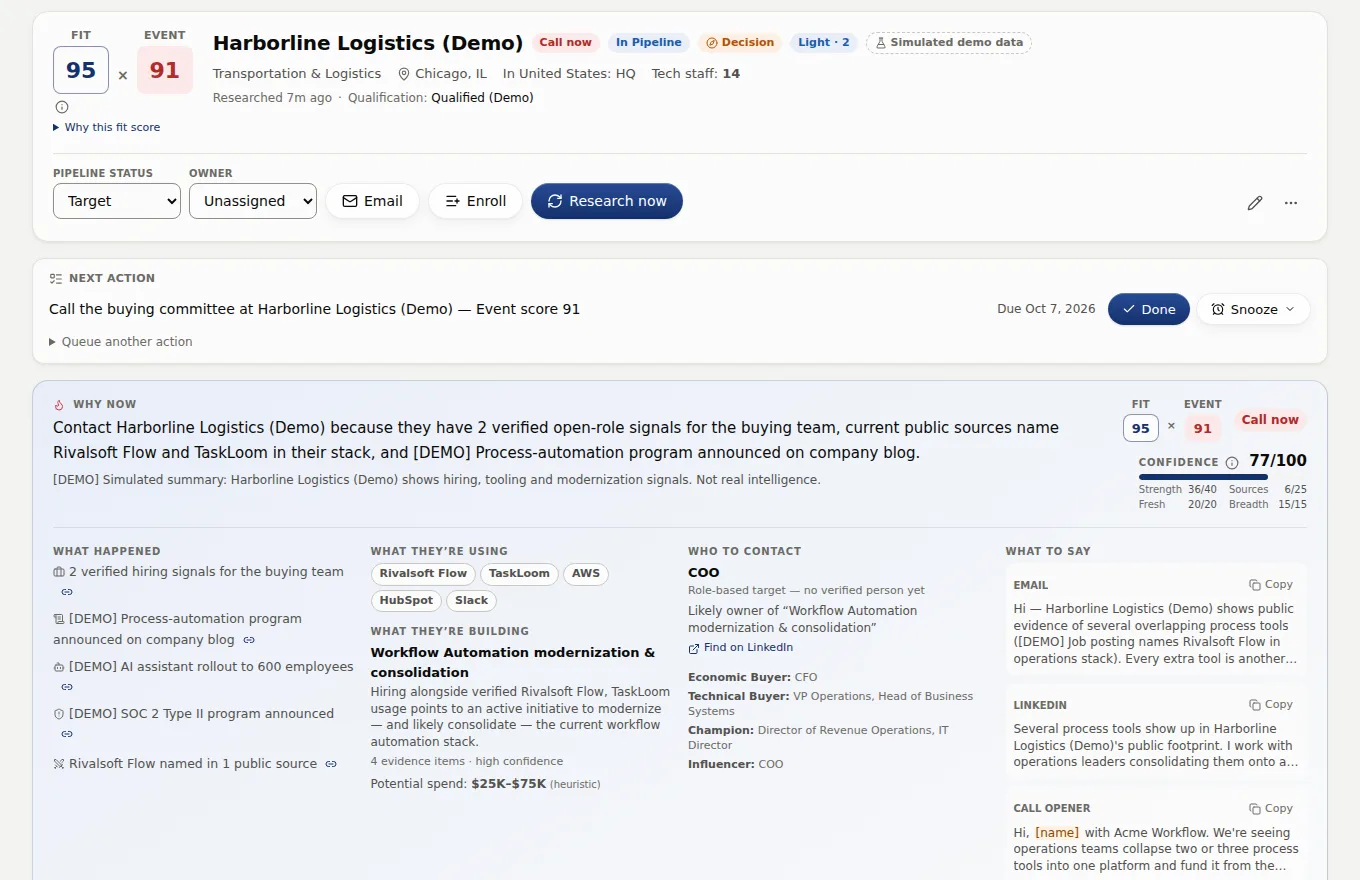
One page per company, built on evidence and written for the person who is about to pick up the phone.
- Why now, in one sentence, with the signals behind it.
- What happened, what they use, and the likely project.
- Who to contact: likely roles, and a named person when a public source names one.
- What to say: a draft email, LinkedIn note and call opener written from the account's sourced evidence.
- A confidence score with its breakdown: evidence strength, corroboration, freshness and signal breadth.
What you get
Everything between a buying signal and your next call.
Fit × Event scoring
Two scores per account. Fit asks whether they are your kind of customer and changes slowly. Event asks whether something is happening now, and decays as signals age. A confidence score shows how much evidence stands behind it.
Today
The companies to contact today, built once each morning. Yesterday's picks come back only with a new signal, so the list does not nag. A card shows the why-now sentence, the signals behind it, a suggested contact and a draft opener, where the account has them.
Sourced research
A research agent reads careers pages, job boards, press releases and news. Research saves findings with their source links and, when the source shows one, the observed date. Anything it cannot verify is marked Needs Verification and scores zero.
Buying committee
Your buyer personas grouped into likely roles: economic buyer, technical buyer, champion and influencer. Research marks a named person Verified only with a public source link (a profile link alone leaves them at Needs Verification); with neither, you get a role-based target.
Competitive intelligence
Evidence of the competing tools already in place, with its source, a confidence level, a displacement play, and the renewal clue when a public source shows one.
Website visitor intent
One snippet on your site turns visits from the networks of companies you track into scored signals. A visit is matched only when the visitor's network name is confirmed and belongs to that company's domain, not by fuzzy name matching. ISP, carrier and cloud networks stay anonymous counts, and a match identifies a network, not a person.
Evidence rules
We would rather show you less than show you something made up.
These rules are applied by the software when research is saved and scored, not just written in a policy.
No source, no score.
A signal without a source URL is stored as Needs Verification and adds nothing to the Event score.
Competitors need sources too.
A competitor claim without a source URL is dropped, and the research instructions forbid inferring a competitor from what a company does.
Research marks a person Verified only with a source.
When research cannot link a source to a named person, it returns a role-based target instead; a name with only a profile link is kept as a Needs Verification lead. The research model has no field for email addresses or phone numbers, so it cannot supply them. A contact you add yourself is stored as you enter it and stays Needs Verification until it has a public source link.
Estimates are labeled or discarded.
A technical-team-size estimate without a source is discarded. A spend range appears only when a verified team size exists, and it is labeled a heuristic.
The low-risk way in
Start with a pilot.
90-Day Intent Pilot, $5,000: give us 500 target accounts, your ICP, personas, and competitors. We surface the companies showing strong buying signals, what triggered them, the likely project, the competitor in place, who to contact, and the recommended outreach. Our guarantee: if we don't identify at least 10 qualified buying events during the pilot, we extend your monitoring another 90 days at no cost. Convert to annual and the $5K is credited to the contract.
Invoiced. No credit card required to start.
Questions
Straight answers.
What is customer intent intelligence?
It finds which companies are likely to buy now, using evidence from public sources and, if you install the snippet, visits to your own site. Then it tells your team who to contact, why now, and what to say.
Where does the evidence come from?
Public pages: careers pages, job boards, press releases and news. The research agent saves findings with the URLs they came from. You can also record a signal yourself when you learn something first-hand.
How quickly do results arrive?
Research runs in overnight batches rather than on demand, so a long list is worked through over several nights. New results and alerts appear as each batch finishes.
Do you invent contacts or email addresses?
No. Research marks a named person Verified only when it can link a public source; a name with only a profile link stays Needs Verification, and with neither you get a role-based target to look for. The research model has no field for email addresses or phone numbers, so it cannot supply them. Contacts you add yourself are stored as you enter them and stay Needs Verification until they have a public source link.
Does it replace my CRM?
It is a lightweight CRM for the work around intent: accounts, next actions and pipeline. It pushes an account and its best contact to OnePageCRM and HubSpot, and it is deliberately not a full replacement for the system your team already sells from.
How is it priced?
By accounts monitored, not per seat; each plan includes a set number of users. The 90-day pilot is the low-risk way in, and its fee is credited to the contract if you convert to an annual plan. Plans are invoiced; no credit card is required to start.
What does the pilot guarantee?
If we don't identify at least 10 qualified buying events during the pilot, we extend your monitoring another 90 days at no cost.
How are opt-outs handled?
The footer of a sales email carries your organization's name, your mailing address and an unsubscribe link, and email is held until a mailing address is on file. An unsubscribe (the person presses the button on the page the link opens, uses their mailbox provider's unsubscribe button, or replies with what is essentially just a request to stop) puts that address on your organization's do-not-email list; sends are checked against that list, and the person's sequences end. A reply that only mentions stopping raises an alert for your rep and adds nothing to the list. Email is sent from a Diurno HQ sending address on your behalf, once sending is switched on.